Developing The Human Behind The Camera

Last week started with the news of the passing of Martin Parr, one of the great Magnum photographers. Martin Parr photographed how we behave in our free time. With we I mean humanity. Even though a lot of his work was focussed on the English at leisure, I think that it serves as a mirror for at least most of us humans. Read more about Martin Parr on the Magnum Website
He was initially criticised for ridiculing or mocking the behaviours of the working class, but his work serves as a mirror. Not just mirroring what his eye was attracted to but reflecting to the viewer parts that would feel familiar, even if uncomfortably so. To assume that only the photographer is biased about the sorts of scenes he or she photographs is of course a mistake. A mirror image is hardly ever looked at unbiased. Looking at a reflection can bring up all kinds of insecurities for the viewer and can therefore feel uncomfortable.
Martin Parr was a devoted documentary photographer, but his sense of humour helped him tell stories with double layers. To just think of the pictures as funny would be selling them short. When looking at some of the images of his book Last Resort I can’t help but wonder about where humanity is heading. The same goes for the more recent work for Death by Selfie. Even though of course the pictures can be seen as criticism on modern day living, he happily joined in when people wanted a selfie with him. The viewer’s personality will be the deciding factor if offense will be taken, or if it leads to pause for thought. The photos being just as much a mirror image of modern day living as they are a clear reflection of the photographer's way of seeing.
The mirror image is neutral until it is observed with a biased mind. We are all in some way biased. We see through a filter consisting of experiences and past pain. We see with sensitivities of our own that we lay upon what we see. This then becomes part of our interpretation.
I see the work of an observer with a very keen eye. My personality leads me to being worried about where humanity is heading. How can we not see that we do not see anymore? How can we not see that we rob ourself of experiencing things by just photographing ourselves in places or experiences that could have meant a great deal to us? How can we not see that not experiencing things, not seeing, feeling and interpreting things, rob the mind of what is most valuable? Memories, real interactions, savouring what we see, becoming more whole…Of course my view on this comes from having lived long enough to realise the value of memories, of having gone through enough hard times to know better than to waste time, to not cherish true interactions with people and to not soak in the good times and meaningful experiences whenever I can.
My train of thought lead me to the question why we photograph? Do we photograph to get that same perfect shot that we have seen from some other photographer, to use as social proof that “we were there “, to combat FOMO ( fear of missing out) or because we want to experience something more fully, want to try to make art, want to exercise our creativity or would like to put photographs to our memories? To raise concern or questions, to provoke thought, to document or perhaps to urge others to take action.

Do we have a passion for getting a perfect picture of a perfect location or do we have a passion for photography and what is it that fuels our passion? Joel Meyerowitz once said that he looks for the humanity of the photographer in the photographs. This implies some kind of engagement with the subject that goes beyond :look at how terrible the state of the world is or on the flip side ; Look at how pretty this is. A good photograph is a testament to the humanity and engagement of the photographer.
Martin Parr was forever chasing the 6 to 8 great pictures per year. He knew that the only way to do this was to shoot a lot, to get loads of practice in seeing, observing, reacting. He must have had an incredible ability to focus on the scenes that would tell his double layered stories in brightly coloured photographs. In order to tell something that was serious he had to make an image also look amusing. This grabbed the attention before it started to raise questions not as much as what the people in the image were doing, but what WE are doing.
His work affected me. A fact that might surprise those who think of me as merely interested in forest or landscape photography. I was affected as a human being and a creative person. To be affected by someone else’s work, to allow other people’s creativity to raise questions and to be urged to think deeper is a privilege. I seek these kinds of experiences in the work of those that do not work in my own niche. I find it too restricting to just look at the work of those that share the same love for nature and the forest. Photography has a rich history with many great photographers working in all kinds of areas. Art has an even longer and richer history and artists have tried to affect us in all kinds of ways. Does art always have to be instantly pleasing, easy on the eye? When I was younger I used to think so. Nowadays I’d much rather look at art that I find more difficult to like at first glance. I prefer to expand my horizons. Martin Parr’s work did not immediately appeal to me, but the visual language he used affected me deeply and it made me think.
Photography that does not just consist of pretty pictures, but which requires a closer look, which challenges us, which might even challenge what we believe photography should be, which tells an entire story without words, which needs our involvement instead of the quick like or thumbs up, is something that is exactly what we should be looking at if we want to keep our brain active and want to create for ourselves new pathways in our brain which will in turn give us fresh ideas, a wider understanding of the world around us and of ourselves.
Just recently there was a huge disastrous fire in Hong Kong, killing many people. The story was covered in the media in words, video and live blogs, but there was one photo that told the entire story and the emotional impact of it that was stronger than all the other news coverage. A photograph that also showed the humanity of the photographer which communicates something in a way that we can all relate to. The name of the Reuters photographer is Tyrone Siu. If you have not seen the photograph, you can find it here on the Reuters website
My bookshelves are overflowing with books from photographers, but hardly any from landscape or nature photographers (with the exception of Theo Bosboom's books). Most of them are photographers that started out in film photography, in the analogue era. Masters of their craft. People like Joel Meyerowitz, Saul Leiter, Henri Cartier-Bresson and Robert Frank. But also books by Nick Brandt, someone who masters storytelling in his powerful fine art images that are a huge testament to his dedication to showing the effects of climate change on people and animals alike. I also have many books by black and white photographers like Alan Schaller, Phil Penman and Hengki Koentjoro. None of these photographers are working in my niche, but looking at their work makes me, the originator of my work, richer. I encourage you to look beyond what is just easy on your eye, beyond your own niche. Find the work of great photographers, learn from looking at their work, read about them, let them expand your horizons and be grateful that many of these great masters have laid the foundations of something that means so much to us.
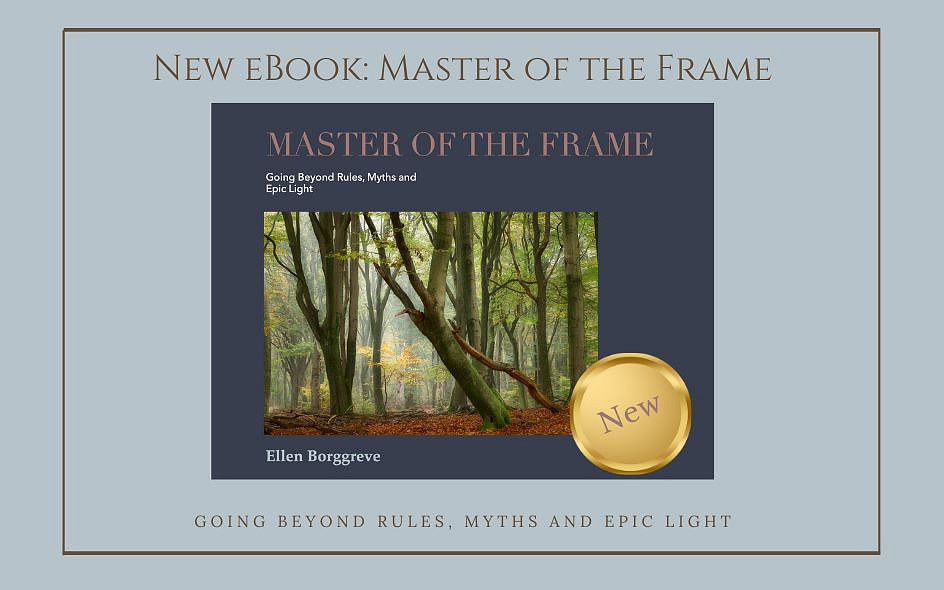
If you would like to support this unsponsored blog without advertising and make it possible for me to keep writing these articles, please consider purchasing one of my eBooks, for example the recently released Master of the Frame eBook. I appreciate your support so much.